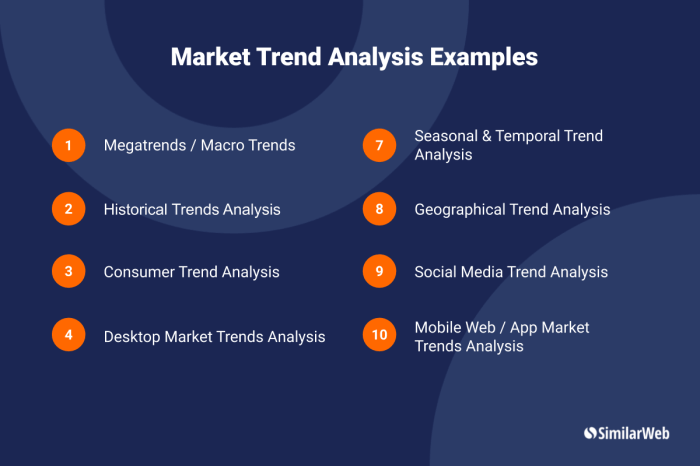
Delving into the realm of market trends analysis, this guide offers a detailed exploration of the importance and impact of understanding market dynamics for businesses. From market analysis techniques to leveraging research findings, this comprehensive overview equips you with the essential tools to navigate the ever-evolving market landscape.
Introduction to Market Trends Analysis
Understanding market trends is crucial for businesses to stay competitive and relevant in today’s dynamic environment. By analyzing market trends, companies can anticipate changes, identify opportunities, and mitigate risks.
Staying informed about market trends allows businesses to adapt their strategies, products, and services to meet the evolving needs and preferences of consumers. It also helps in forecasting demand, setting prices, and developing marketing campaigns that resonate with the target audience.
Impact of Market Trends on Decision-Making Processes
Market trends play a significant role in shaping the decision-making processes of businesses. Here are some key ways in which market trends influence decision-making:
- Identifying Emerging Opportunities: By analyzing market trends, businesses can identify emerging opportunities in new markets or industries.
- Forecasting Demand: Understanding market trends helps in accurately forecasting demand for products or services, allowing businesses to adjust production levels accordingly.
- Competitive Analysis: Monitoring market trends enables businesses to conduct competitive analysis and stay ahead of competitors by offering innovative solutions.
- Risk Mitigation: Being aware of market trends allows businesses to anticipate potential risks and challenges, enabling proactive risk mitigation strategies.
Market Analysis Techniques

Market analysis techniques involve various methods to understand and predict market trends. These techniques help businesses make informed decisions based on data-driven insights.
Qualitative vs Quantitative Market Analysis
Qualitative market analysis focuses on understanding the underlying reasons and motivations behind consumer behavior. This approach involves gathering data through interviews, focus groups, and observations to gain insights into customer preferences, opinions, and attitudes. On the other hand, quantitative market analysis involves using numerical data and statistical models to analyze market trends. This approach relies on data such as sales figures, market share, and customer demographics to identify patterns and forecast future trends.
Tools and Software for Market Trend Analysis
- Google Trends: A free tool that provides insights into search trends and popular topics.
- MarketSight: Software for analyzing survey data and creating visualizations.
- Tableau: Data visualization software that helps in uncovering trends and patterns in market data.
- Statista: A platform offering statistics and market data from various industries for analysis.
Market Research Strategies
When it comes to analyzing market trends, having a strong market research strategy is crucial. This involves gathering data and information to understand the current market landscape and make informed decisions for the future.
Importance of Primary and Secondary Market Research
Primary market research involves collecting data directly from the source through surveys, interviews, or observations. This type of research provides first-hand information and can be tailored to specific needs.
On the other hand, secondary market research involves analyzing existing data that has already been collected by others. This can include reports, studies, and articles. While secondary research is less time-consuming and costly, it may not always be as specific or relevant as primary research.
Tips for Gathering Data for Market Trend Analysis
- Utilize online surveys and questionnaires to collect data from a large pool of respondents.
- Conduct interviews with industry experts, customers, and stakeholders to gain valuable insights.
- Analyze social media trends and consumer behavior to understand market sentiment.
- Monitor industry reports, news articles, and competitor activities to stay informed about market changes.
- Utilize data analytics tools to track and analyze key metrics related to market trends.
Understanding Market Volatility
Market volatility refers to the degree of variation in the price of a financial instrument within a certain period. This fluctuation can have significant implications for businesses, affecting decision-making, profitability, and overall stability.Factors contributing to market volatility can include economic indicators, geopolitical events, natural disasters, changes in government policies, and market sentiment. For example, a sudden change in interest rates by the central bank can lead to fluctuations in stock prices, currency values, and bond yields.
Implications of Market Volatility
Market volatility can make it challenging for businesses to predict future cash flows, plan investments, and manage risks effectively. It can also impact consumer confidence, leading to changes in spending patterns and demand for products and services.
- Increased uncertainty: Businesses may find it difficult to make long-term strategic decisions due to unpredictable market conditions.
- Risk of losses: Sudden price movements can result in financial losses for businesses that are not prepared to manage market volatility.
- Opportunities for gains: While market volatility poses risks, it can also create opportunities for businesses to capitalize on price fluctuations and generate profits.
Strategies to Mitigate Risks
To mitigate risks associated with market volatility, businesses can implement the following strategies:
- Diversification: Spreading investments across different asset classes can help reduce the impact of market fluctuations on overall portfolio performance.
- Hedging: Using financial instruments such as options, futures, and derivatives can help protect against potential losses due to adverse price movements.
- Stress testing: Conducting scenario analysis to assess the impact of extreme market conditions on business operations and financial health.
Utilizing Market Research Findings
Market research findings play a crucial role in helping businesses make informed decisions and stay ahead of the competition. By leveraging these insights, companies can identify new opportunities, mitigate risks, and tailor their strategies to meet the needs of their target market.
Identifying Opportunities and Threats
Market research helps businesses identify emerging trends, consumer preferences, and gaps in the market that can be turned into profitable opportunities. By analyzing customer feedback, purchasing patterns, and competitor strategies, companies can uncover hidden opportunities for growth and innovation. On the flip side, market research also enables businesses to detect potential threats such as changing consumer behaviors, industry disruptions, or competitive market entries.
By staying vigilant and proactive, companies can address these threats before they escalate into major challenges.
Real-life Examples
- Apple Inc. used market research to identify the growing demand for wearable technology, leading to the development of the Apple Watch. By analyzing consumer preferences and market trends, Apple capitalized on this opportunity and created a new revenue stream.
- Coca-Cola conducted market research to understand shifting consumer preferences towards healthier beverages. This insight prompted the company to diversify its product portfolio by introducing new low-sugar and organic drink options, adapting to the changing market landscape.
- Amazon leveraged market research to identify the need for faster delivery options in the e-commerce industry. By investing in Prime membership with expedited shipping, Amazon enhanced customer loyalty and gained a competitive edge over rivals.
In conclusion, mastering the art of analyzing market trends is not just a valuable skill but a strategic imperative for businesses looking to thrive in competitive environments. By staying informed, utilizing the right tools, and interpreting data effectively, companies can make informed decisions that drive success and growth.
FAQ Section
How often should market trends be analyzed?
Market trends should ideally be analyzed regularly, depending on the industry and the pace of change within it. Monthly or quarterly reviews are common practice.
What are some free tools for market trend analysis?
Some popular free tools for market trend analysis include Google Trends, Social Mention, and Think with Google.
Is qualitative or quantitative market analysis more accurate?
Both qualitative and quantitative analysis have their strengths; qualitative analysis provides insights into customer behavior and preferences, while quantitative analysis offers statistical data for precise measurements.


